· Samir Abid · AI Strategy · 6 min read
What AI Can Actually Do for Your Business Today
A practical guide to where AI fits in a business today, from communication and research to knowledge systems, internal tools, agents and workflow automation.
Most business leaders do not need another abstract explanation of AI.
The useful question is more practical: what can AI actually do for your business today, and where does it fit in the work already happening?
The answer is not one thing. AI can help with thinking work, communication, research, knowledge, internal tools and repeatable workflows. Some of that work can be useful quickly. Some needs better data, clearer processes, or human review before it is worth trusting.
A useful way to split it is this:
- AI that thinks with you. It helps you understand, write, compare and decide.
- AI that works for you. It carries out defined tasks inside a workflow.
That distinction matters. It stops AI being treated as one large, vague technology and turns it into a set of practical choices.
AI That Thinks With You
For clearer communication, faster understanding and better prepared decisions.
💬 Language & Communication
This is often the easiest place to start because the work is familiar and the output is easy to check.
- Draft emails, reports, presentations and posts - From internal updates to client proposals
- Adapt tone, language and level of detail - The same message for different audiences
- Summarise meetings, documents and articles - Pull out the useful points quickly
- Prepare talking points and responses - A better first draft when time is tight
What this makes possible: routine communication work can move faster, while a person still keeps judgement over the final message.
🔍 Research & Insight
AI is useful when the job is to work through a lot of material and bring the relevant parts closer to the decision.
- Synthesise public and internal information - Bring related material into one view
- Find patterns, trends and gaps - Especially across repeated documents or customer conversations
- Track competitors and market shifts - Turn periodic checking into a repeatable process
- Reduce time-to-understanding across roles - Help people get to the useful context faster
What this makes possible: people spend less time gathering background and more time deciding what to do with it.
🧠 Strategy Co-Creation
AI does not replace judgement. It can make the thinking process more visible.
- Structure decisions and compare options - Put messy thinking into a usable shape
- Challenge assumptions and reframe problems - Useful when the first answer feels too narrow
- Develop frameworks, messaging and positioning - A starting point for sharper thinking
- Act as a thinking partner - Especially when you need to work through a problem before involving others
What this makes possible: better prepared conversations and fewer blank-page moments. The condition is that a person still owns the decision.
AI That Works For You
For defined tasks, repeatable processes and systems that support the team.
🧭 Agentic AI Systems
These are AI systems that carry out defined tasks. They work best when the task has clear inputs, clear rules and an output someone can review.
- Content assistant – Drafts posts, emails and internal comms from a brief
- Email triage assistant – Sorts, labels and drafts replies for review
- Report writer – Builds regular summaries from live data
- Customer service agent – Answers common questions using company knowledge
- Sales support agent – Enriches leads, drafts follow-ups and updates records
- Analytics assistant – Turns raw data into written summaries or visual outputs
- Project planner – Creates first-pass plans and timelines from briefs
- Calendar assistant – Books meetings, sends reminders and follows up
What this makes possible: frequent, structured tasks can happen with less manual handling. The important condition is review. AI agents should earn autonomy rather than be given it on day one.
📚 Knowledge-as-a-Service
Most businesses already have useful knowledge. It is just spread across PDFs, folders, slide decks, SOPs, emails and people.
- Ask questions of PDFs and internal documents - Find answers without manually searching folders (see What I Learned Building a RAG System)
- Build internal GPTs on company material - Make company-specific knowledge easier to access
- Turn SOPs and reports into searchable systems - Reduce dependence on who remembers where things are
- Support onboarding and consistency - Give people a better starting point
What this makes possible: institutional knowledge becomes easier to use. This works best when the source material is reasonably current, named clearly and kept in the right place.
🧱 Tool & Product Building
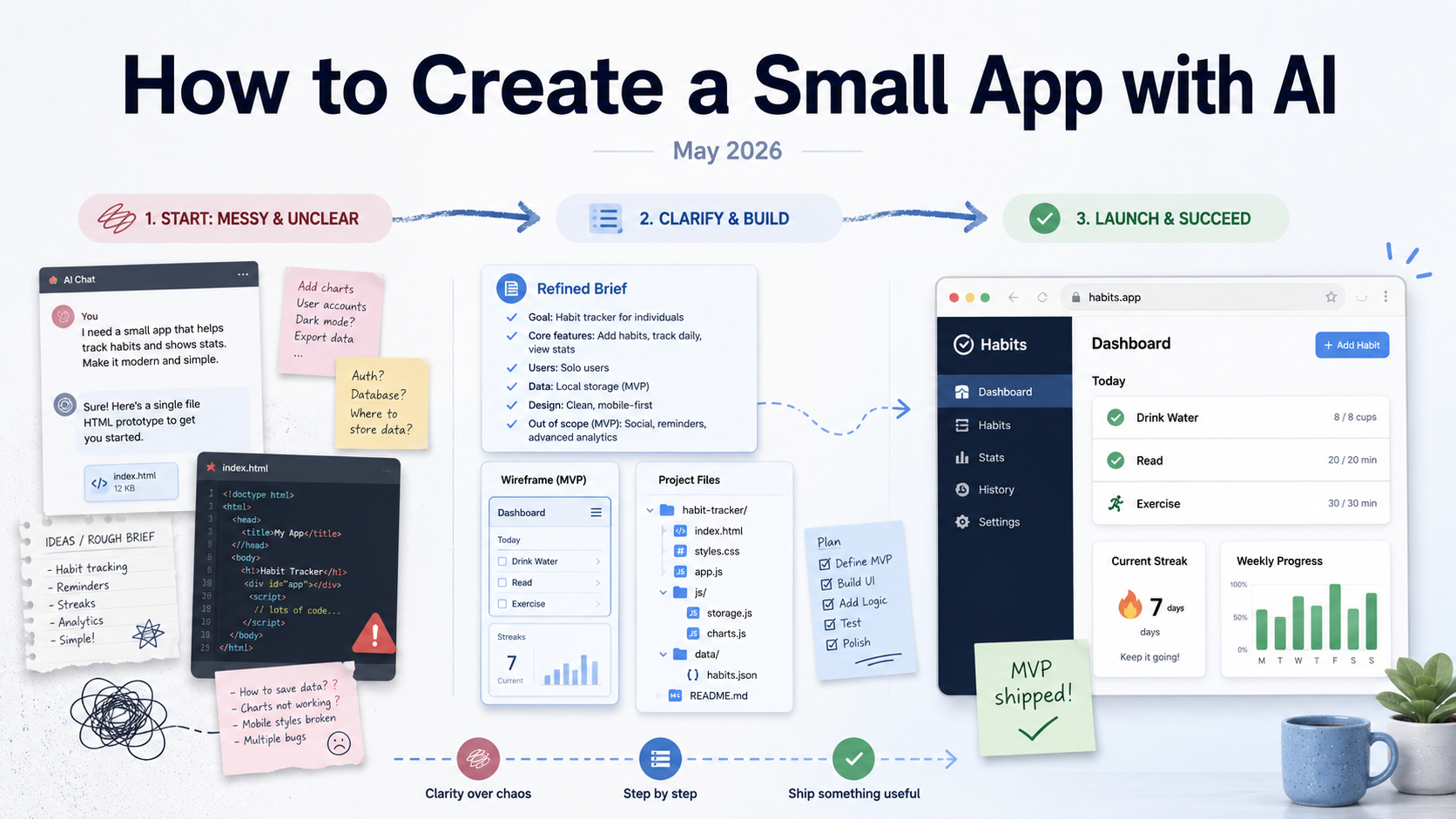
AI can now help build working software, especially small tools and prototypes.
- Build apps, dashboards and prototypes - Turn a clear idea into something you can use in the browser
- Write and maintain internal tools - Useful where the process is understood but the tooling is missing
- Extend older systems with better interfaces - Make existing data easier to work with
- Support experimentation before larger investment - Test whether the workflow is worth building properly
What this makes possible: you can test ideas and build internal tools before committing to a full development project.
If you want a practical route for this specific use case, I wrote a May 2026 guide here: How to Create a Simple App with AI in May 2026.
🤖 Workflow Automation
This is where AI becomes useful inside the flow of work rather than sitting in a separate chat window.
- Route data between tools (CRM, Notion, Slack, email and others) - Reduce copy-and-paste work
- Trigger actions from events (for example: lead created → email drafted → CRM updated) - Make the next step less dependent on memory
- Format, tag and distribute content - Keep routine outputs consistent
- Enrich records, sync reports and update dashboards - Keep working data closer to current
- Create dependable, multi-step automations - Useful when the process is understood and repeated often
What this makes possible: less time spent moving information between systems. The process needs to be mapped before it is automated.
The bottom line
The useful starting point is not to transform the whole business.
Pick one workflow where the work is frequent, the rules are knowable, and the output can be checked by a person.
That might be a weekly report, a knowledge base, an internal tool, a customer support workflow, or a set of communications that always starts from the same raw material.
The opportunity is to put AI close to real work, learn what improves, and then widen carefully.
Ready to start?
The best way to understand what AI can do for your business is to build one useful thing and see how it behaves in the real workflow.
That is exactly what we help you do.
Book a Discovery Call →Or email Samir directly: info@paceinsights.com